Most articles on mobile app development cost open with a $10,000 to $500,000 range and stop there. That answer is technically accurate and practically useless. The real question is not “how much does an app cost?” – it is “how much will my specific app cost, given my features, my platform choice, my team’s location, and my growth horizon?”
This guide is written for product owners, CTOs, and founders who need to build a defensible business case before engaging a vendor. Every cost range here is grounded in 2026 market data across platform types, feature sets, team geographies, and compliance requirements. By the end, you will know what drives cost, how to estimate your project within a tight range, and which questions to ask before you sign a contract.
How is mobile app development cost actually calculated?
The single most important insight in app budgeting is that cost is not a number it is a formula. The industry-standard equation is straightforward:
Estimated Cost = (Number of Features × Complexity Weight) × Hourly Rate × Estimated Development Hours
Or, broke down by project phase:
Discovery (10%) + Design (15%) + Development (50%) + QA & Testing (15%) + Deployment & Launch (10%) = Total Build Cost
To this total, you must add 15 – 25% annually for ongoing maintenance from year one onward. An app that costs $100,000 to build will cost roughly $20,000 per year to keep secure, OS-compatible, and competitive, every year, indefinitely.
Cost is the output of at least seven interacting factors. Any quote that does not account for all seven is either incomplete or padded for risk.
- App complexity: number of screens, business-logic depth, third-party integrations
- Platform choice: iOS only, Android only, both native, or cross-platform
- Design intensity: template-based UI versus custom UX with motion and brand systems
- Backend architecture: monolith versus microservices, scalability requirements
- Compliance burden: HIPAA, PCI-DSS, GDPR, SOC 2, regional data residency
- Team geography & seniority: hourly rate, communication overhead, time zone
- Engagement model: fixed-price, time and materials, or dedicated team
How mobile app development cost is actually calculated in 2026
What are real mobile app development costs by tier in 2026?
Industry data compiled from thousands of app development projects in 2025–2026 puts the average cost of custom mobile app development at roughly $171,000, though most small-to-mid business applications fall between $50,000 and $120,000. The wide spread reflects how dramatically scope, features, and team selection affect the final number.
The most defensible way to budget is to bucket your project into one of four complexity tiers.
Tier 1 – Simple App / MVP ($15,000 – $50,000)
A Minimum Viable Product designed to validate a single business hypothesis. Basic UI, limited screens (under 15), no heavy backend, single platform or cross-platform with shared codebase.
- Typical features: authentication, basic CRUD, simple list/detail screens, push notifications, single payment integration
- Timeline: 8 – 12 weeks
- Example use cases: loyalty card app, restaurant menu app, fitness tracker, internal team tool
Tier 2 – Mid-Complexity Application ($50,000 – $150,000)
A production-ready business app with custom UI/UX, user accounts, API integrations, and payment processing. Covers most e-commerce, SaaS, and service marketplace applications.
- Typical features: custom design system, multi-role authentication, payment gateway (Stripe / PayPal / regional PGs), real-time notifications, admin dashboard, basic analytics, third-party API integrations
- Timeline: 4 – 6 months
- Example use cases: e-commerce app with subscriptions, fitness app with custom workout plans, B2B service platform, on-demand marketplace
Tier 3 – Complex Feature-Rich App ($150,000 – $300,000)
A scalable platform with real-time data, GPS, complex business logic, and advanced security requirements.
- Typical features: real-time GPS tracking, complex matching algorithms, live chat, video streaming, ML-based recommendations, multi-tenant architecture, advanced analytics, social features
- Timeline: 6 – 9 months
- Example use cases: ride-hailing platform, food delivery, telehealth app, social network, financial trading app
Tier 4 – Enterprise-Grade Platform ($300,000 – $500,000+)
A mission-critical system with strict compliance, agentic AI workflows, LLM integration, ERP/CRM connectivity, and high-availability infrastructure.
- Typical features: SOC 2 / HIPAA / PCI-DSS compliance, biometric authentication, end-to-end encryption, ERP/CRM integration, generative AI workflows, vector databases, multi-region deployment, 99.99% SLA
- Timeline: 9–18 months
- Example use cases: digital banking platform, custom telehealth EHR, enterprise field operations, regulated fintech
Tier Build Cost Timeline Annual Maintenance Simple / MVP $15K – $50K 8 – 12 weeks $3K – $10K Mid-Complexity $50K – $150K 4 – 6 months $10K – $30K Complex $150K – $300K 6 – 9 months $30K – $60K Enterprise $300K – $500K+ 9 – 18 months $60K – $125K+
Adding Generative AI or agentic workflows to any tier adds a 20 – 50% premium, with an additional $15,000 – $80,000 expected for LLM integration, vector databases, and prompt engineering.
From $15k mvp to $500k+ enterprise, the four real tiers of mobile app development cost in 2026
What does each feature actually cost?
Vendor quotes become comparable only when broken down to the feature level. The following ranges reflect 2026 market data for production-quality implementations including QA and edge-case handling.
| Feature | Description | Cost (USD) |
|---|---|---|
| Authentication (email + social) | Login, signup, OAuth, password recovery | $2,000 – $6,000 |
| User profiles & roles | CRUD profiles, role-based access | $3,000 – $8,000 |
| Push notifications | FCM/APNs, segmentation | $1,500 – $5,000 |
| Payment integration | Stripe, PayPal, Apple/Google Pay, regional PGs | $5,000 – $15,000 |
| In-app chat | 1:1 or group, real-time | $8,000 – $25,000 |
| Geolocation & maps | Mapbox/Google Maps, location-based features | $4,000 – $12,000 |
| Search & filtering | Elasticsearch, faceted search | $5,000 – $15,000 |
| Admin dashboard | Web-based control panel | $8,000 – $25,000 |
| AI/ML recommendations | Personalization engine | $15,000 – $50,000 |
| Video streaming | Live or VOD, HLS/DASH | $15,000 – $45,000 |
| Offline mode & sync | Local cache, conflict resolution | $6,000 – $20,000 |
| Biometric authentication | Face ID, Touch ID, secure enclave | $3,000 – $10,000 |
| Analytics integration | Firebase, Mixpanel, Amplitude | $2,000 – $6,000 |
| Multi-language (i18n) | Per additional language | $1,500 – $5,000 |
iOS vs Android vs cross-Platform, which approach saves more?
Platform selection is the single most leverage-able cost decision in your project. Get it right and you cut your bill nearly in half. Get it wrong and you pay twice for the same app.
Native development (iOS + android separately)
Building two separate native apps using Swift for iOS and Kotlin for Android delivers maximum performance and full access to platform-specific APIs. The downside is obvious: you are essentially funding two parallel codebases, two QA tracks, and two release pipelines.
- Cost impact: +80 – 100% versus single platform
- Best for: apps requiring deep hardware access (AR/VR, real-time video processing, advanced sensors), regulated industries requiring biometric secure enclave access, or platform-specific UX excellence
Cross-platform (Flutter or react native)
A single codebase deployed to both iOS and Android. In 2026, Flutter and React Native have matured enough to cover 90% of business use cases with 85 – 90% of the native experience at 70 – 80% of the cost.
- Cost impact: 30 – 50% savings versus dual-native development
- Best for: most B2B and consumer apps, MVP launches, content-driven apps, e-commerce, SaaS dashboards
Progressive web apps (PWA)
A browser-based app installable to the home screen with offline support. PWAs typically cost 20 – 35% less than equivalent mobile apps because there is no native device API complexity and no App Store review process.
- Cost impact: cheapest option
- Best for: lightweight installable experiences, content delivery, internal tools, markets with low app-store adoption

Native iOS + Android vs cross-platform vs PWA, the three paths to a mobile app, and which one saves you 30- 50% in 2026
Where does geography drive your hourly rate?
The same senior mobile developer commands wildly different rates depending on where they sit. Below are 2026 market averages for mid-to-senior level developers working with reputable agencies (not bargain-bin freelancers).
| Region | Hourly Rate (USD) | Time Zone Overlap (vs US ET) | Notes |
|---|---|---|---|
| United States | $100 – $180 | Native | Highest rates, includes benefits & overhead |
| Western Europe | $70 – $130 | 5 – 6 hr | Strong engineering culture, GDPR-native |
| United Kingdom | $85 – $120 (£) | 5 hr | Premium fintech & enterprise expertise |
| Eastern Europe (Poland, Ukraine, Romania) | $35 – $70 | 6 – 7 hr | Strong engineering, EU-aligned compliance |
| Latin America (Brazil, Argentina, Mexico) | $30 – $60 | 0 – 3 hr | Nearshore advantage for US clients |
| India | $20 – $45 | 10+ hr | Largest talent pool, scalability strength |
| Philippines | $25 – $40 | 12+ hr | Strong English, BPO heritage |
| Vietnam | $20 – $50 | 11+ hr (US) / 2 hr (Korea/Japan) | Strong technical talent, growing AI/ML specialization |
The critical caveat – rate is not value
A senior developer at $150/hour delivering in 16 weeks costs the same as a junior team at $50/hour taking 48 weeks and the senior team’s output does not need to be rebuilt in year two. The lowest advertised rate rarely correlates with the lowest total cost of ownership. Look for partners who can demonstrate: line-by-line hourly breakdowns per feature, code quality metrics (test coverage, defect density), client retention beyond 18 months, and direct portfolio match to your domain (fintech, healthcare, e-commerce, IoT).
What are the hidden costs that wreck most budgets?
The total a vendor quotes is almost never the total you pay. The most common cost overruns come from items that do not appear on the initial quote at all. According to industry surveys, 60% of app projects exceed their initial budget, almost always because of items in the list below.
Post-launch maintenance (15-25% of build cost, annually)
Operating systems change. Devices evolve. Bugs surface only after real users start using your app. Maintenance is not optional, it is the cost of staying in business.
- iOS and Android each release major platform updates annually
- Third-party SDKs (payment, analytics, social login) push breaking changes 2 – 4 times per year
- Security patches are issued continuously
- An unmaintained app loses App Store compliance within 12 – 18 months
Infrastructure & cloud hosting
Most apps depend on cloud servers (AWS, Google Cloud, Azure) and third-party services that charge monthly or usage-based fees — not one-time costs. Expect $200–$5,000+ per month depending on scale.
App store fees & compliance
- Apple Developer Program: $99/year
- Google Play Console: $25 one-time
- App Store / Play Store transaction fees: 15–30% of in-app purchases
- App review delays, rejection cycles, and re-submission overhead
Third-party integration complexity
Every external service (payment gateway, mapping, analytics, CRM, ERP) requires integration engineering, error handling, monitoring, and ongoing maintenance. Each integration is essentially a small project of its own, typically adding $3,000-$15,000 per integration in year one and 10-15% of that annually thereafter.
Security & compliance engineering
For apps handling sensitive data (financial, health, personal), security cannot be an afterthought. Budget for:
- OWASP Top 10 vulnerability assessment: $5,000 – $15,000
- Penetration testing: $10,000 – $30,000
- HIPAA / SOC 2 / PCI-DSS compliance: $20,000 – $100,000+
- WAF and infrastructure hardening: $5,000 – $20,000
Discovery, marketing & ASO
The app does not market itself. App Store Optimization, paid user acquisition, and continuous marketing typically equal or exceed the original build cost in year one for consumer apps.
Why does Vietnam offshore deliver the best cost-to-quality ratio in 2026?
The most structural way to reduce mobile app development cost without sacrificing quality is to engage a Vietnam-based offshore development center. This is not about chasing the lowest hourly rate, it is about accessing the optimal intersection of technical capability, communication discipline, and rate structure.
The rate advantage, 50 – 70% savings vs. US and Western Europe
Vietnam’s IT industry has matured into one of the most competitive offshore destinations globally. Average hourly rates range $20 – $50 for mid-to-senior developers, compared to $100 – $180 in the United States and $70 – $130 in Western Europe. For a typical mid-complexity app, this translates to $60,000 – $100,000 in direct savings on an equivalent build.
Vietnam’s IT outsourcing market is projected to reach $1.237 billion by 2029 at a 12.23% CAGR, supported by a deep talent pool of 650,000+ IT professionals with strong specialization in Node.js, React, Flutter, cloud-native development, and emerging AI/ML.
The quality signal – coding talent comparable to top-tier markets
On HackerRank’s global coding benchmark, Vietnam ranks 23rd with a score of 81.1, statistically indistinguishable from South Korea (22nd, 81.7) and ahead of established markets like Turkey and India. Vietnamese developers consistently perform well on complex, enterprise-grade projects in modern frameworks.
The communication advantage – time zone flexibility for both Asia and Western clients
Vietnam (GMT+7) offers a strategic time zone position:
- 2-hour difference with Korea, Japan, and most of East Asia: full overlap during business hours
- 3-hour difference with Australia: gnificant overlap for daily standups
- 5 – 6 hour overlap with European mornings: supports same-day iteration cycles
- Evening overlap with US West Coast: viable for daily syncs
This flexibility is why companies from Korea, Japan, Australia, the US, Canada, and Western Europe have all built dedicated offshore development centers in Vietnam.
Hitek Software – global standards from a Vietnam Base
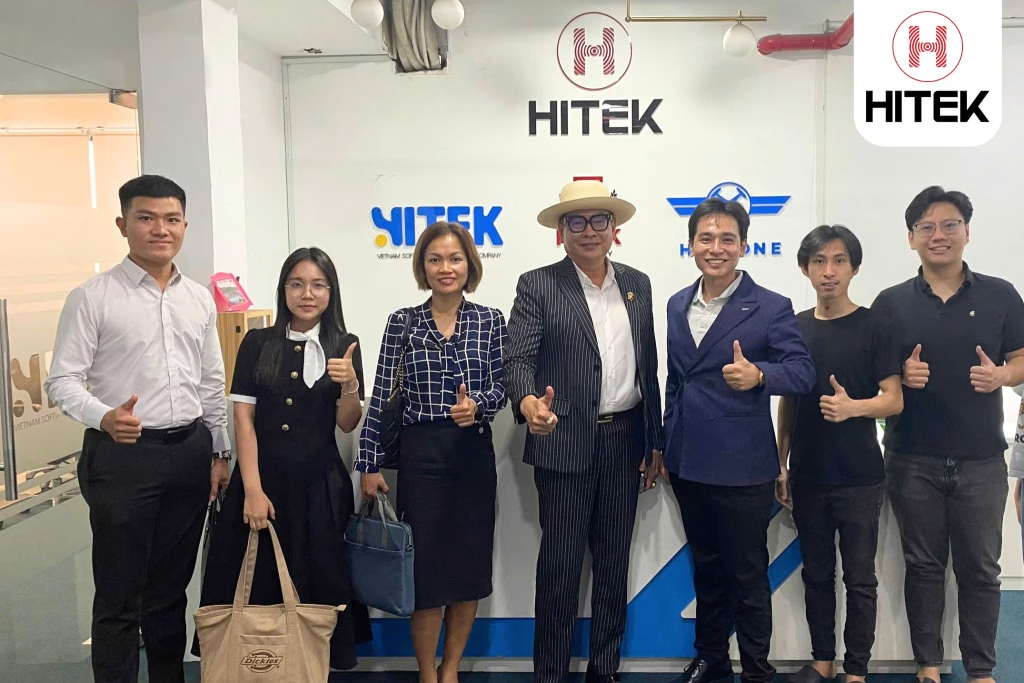
Hitek Software operates from Ho Chi Minh City as a global offshore software development partner serving enterprise and growth-stage clients across Korea, Japan, the US, Canada, and Australia. Our model combines:
- Vietnam cost structure (50 – 70% savings vs. US/Western Europe rates)
- Global delivery standard: Agile/Scrum, CI/CD, code review, QA automation, ISO-aligned processes
- Native-speaker project management in Korean, English, and Japanese – eliminating the communication overhead that erodes savings in cheaper offshore destinations
- Multi-domain expertise: fintech, medical device integration (BLE, OTA), industrial IoT (Modbus, MQTT), e-commerce, AR/VR, and AI-powered platforms
The result: enterprise-grade mobile app development at 30 – 50% of the cost of US-based agencies, with the communication clarity, code quality, and delivery discipline that production businesses require.
How do you get an accurate quote instead of a guess?
The accuracy of any vendor quote is directly proportional to the quality of the brief you provide. “We want to build something like Uber” will get you a $500,000 estimate. A documented PRD will get you a $120,000 estimate ±10%.
The five inputs that move quote accuracy from ±50% to ±10%:
- Product Requirements Document (PRD) — feature list with P0/P1/P2 prioritization
- Wireframes or Figma mockups at minimum 20 – 30 key screens
- Integration inventory every external system (payment, CRM, ERP, analytics)
- Performance & scale targets concurrent users, daily transaction volume, peak load scenarios
- Launch timeline & budget ceiling with phase milestones
A vendor who insists on these inputs before quoting is doing you a favor. A vendor who quotes within an hour of a one-paragraph description is selling you a placeholder number that will quietly drift upward through change orders.
How to Budget Smart in 2026
Mobile app development cost is not a mystery, it is a function of decisions you make in the first two weeks of the project. The teams that ship successful apps in 2026 are not the ones who find the cheapest vendor. They are the ones who:
- Scope rigorously. Move from “an app like Uber” to a documented PRD before requesting quotes. Quote accuracy follows brief quality.
- Start with an MVP. A $30,000 – $80,000 validation build beats a $300,000 vision launch that misses the market. Validate, then scale.
- Default to cross-platform. Flutter or React Native covers 90% of use cases at 50 – 70% of dual-native cost. Reserve native for true platform-specific requirements.
- Budget total cost of ownership, not build cost. Add 40 – 60% to the build quote for year-one realities, maintenance, infrastructure, compliance, and store fees.
- Choose your geography strategically. Vietnam offshore delivers 50 – 70% savings versus US/Western Europe at quality levels comparable to top-tier markets, provided you select a partner with documented global delivery standards.
- Rate is not value. Total cost of ownership beats hourly rate every time. Optimize for delivery quality, communication discipline, and long-term partnership economics.
Building a mobile app in 2026 is not about minimizing the build cost – it is about maximizing the return on every dollar deployed. The right partner makes that math work in your favor from day one.
Get a detailed mobile app cost estimate from Hitek Software
Hitek Software delivers global-standard mobile app development from our Ho Chi Minh City offshore development center, serving clients across the United States, Canada, Australia, Korea, and Japan. From MVP launches under $30,000 to enterprise platforms exceeding $300,000, we provide line-by-line cost breakdowns, dedicated multilingual project managers, and a delivery framework built for production businesses.
📩 Request your free, no-obligation cost estimate by completing the form here.
What you receive within 24 hours:
- ✅ Line-by-line feature cost breakdown
- ✅ Recommended technology stack and platform approach
- ✅ Phase-by-phase timeline with milestone deliverables
- ✅ Team composition and engagement model options
- ✅ Total cost of ownership projection (build + year-one operations)
Why Hitek Software:
- 50 – 70% cost savings versus US-based development at equivalent quality
- Dedicated PM with native-level English, Korean, or Japanese
- Multi-domain experience: fintech, healthcare, IoT, e-commerce, AI
- Agile delivery, CI/CD pipelines, QA automation built into every project
- Global client base across 5 countries with long-term partnership track record