The digital landscape in Australia is evolving rapidly, and web application development is at the heart of this transformation. Whether you’re a startup founder, a business leader, or a developer, staying ahead in 2025 means understanding the latest frameworks, security protocols, and user experience strategies shaping the industry.
This guide explores the key trends, technologies, and best practices that will define web app development in Australia next year, helping you build faster, smarter, and more scalable solutions.
Why Web App Development Matters More Than Ever in 2025
With 85% of Australians now shopping online and businesses increasingly relying on cloud-based tools, web applications are no longer optional—they’re essential. From AI-driven chatbots to progressive web apps (PWAs), the demand for seamless, high-performance digital experiences is surging.
In 2025, developers must focus on:
✔ Performance optimization (Google’s Core Web Vitals still rule SEO)
✔ Enhanced security (cyber threats are growing)
✔ AI and automation (more intelligent workflows, personalized UX)
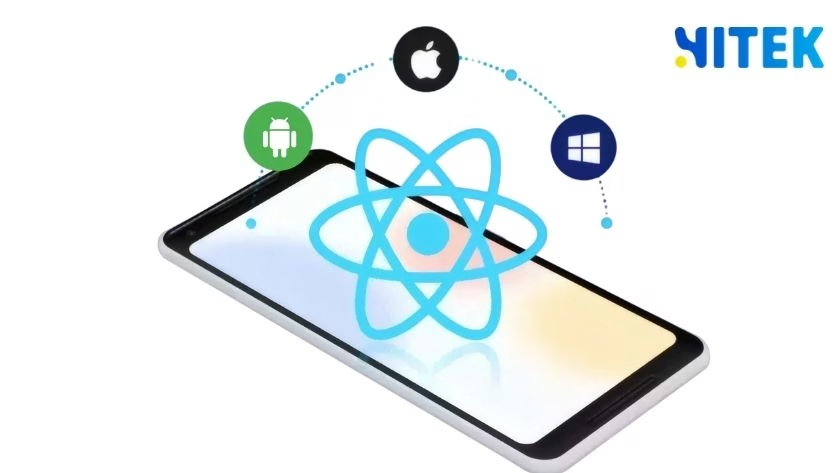
✔ Cross-platform compatibility (mobile-first remains key)
Let’s break down what’s shaping the future.
Top Web App Development Trends in Australia (2025)
1. AI & Machine Learning Integration
AI isn’t just a buzzword—it’s transforming how apps function. Expect more:
- Predictive analytics (e.g., personalized shopping recommendations)
- AI-powered chatbots (like ChatGPT integrations for customer support)
- Automated testing & debugging (tools like DeepSeek’s AI coding assistant)
Businesses leveraging AI will see faster development cycles and higher user engagement.
2. Progressive Web Apps (PWAs) Dominate
PWAs blend the best websites and mobile apps—offline access, push notifications, and app-like speed. Major Australian brands like JB Hi-Fi and Woolworths already use them to boost conversions.
Why PWAs win in 2025:
✅ No app store dependency
✅ Lower development costs
✅ Better performance than traditional mobile sites
3. Voice Search & Conversational UI
With 40% of Aussies using voice search, apps must adapt. Expect more:
- Voice-activated navigation
- Natural language processing (NLP) integrations
- Voice commerce (V-commerce) capabilities
4. Cybersecurity as a Priority
Australia’s cybercrime costs hit $42 billion in 2023—secure coding practices are non-negotiable. Developers must prioritize:
- Zero-trust architecture
- Biometric authentication (face ID, fingerprint scans)
- Regular penetration testing
5. Serverless Architecture & Edge Computing
Serverless setups (like AWS Lambda and Google Cloud Functions) reduce costs and improve scalability. Meanwhile, edge computing (processing data closer to users) cuts latency, which is crucial for real-time apps.
Best Frameworks for Web App Development in 2025
| Framework | Best For | Key Benefit |
|---|---|---|
| React.js | Dynamic UIs | High-performance, reusable components |
| Next.js | SEO-friendly apps | Server-side rendering, fast load times |
| Vue.js | Lightweight apps | Easy learning curve, flexibility |
| Node.js | Backend services | Scalable, handles high traffic |
| Django | Secure, data-heavy apps | Built-in admin panel, Python-based |
For startups: Next.js + Node.js offers speed and scalability.
For enterprise apps, Django provides robust security.
How to Future-Proof Your Web App Development Strategy
1. Adopt a Mobile-First Approach
With 75% of Aussies browsing on mobile, responsive design is critical. Use Flexbox, CSS Grid, and adaptive images to ensure smooth performance.
2. Optimize for Core Web Vitals
Google’s ranking factors include:
- Largest Contentful Paint (LCP) – Load speed matters
- First Input Delay (FID) – Interactivity should be instant
- Cumulative Layout Shift (CLS) – Avoid visual instability
3. Leverage Microservices Architecture
Instead of monolithic apps, break functions into independent services. This improves scalability and makes updates easier.
4. Prioritize Accessibility (a11y)
Australia’s Disability Discrimination Act requires apps to be accessible. Use:
- Semantic HTML
- ARIA labels
- Keyboard navigation support
5. Continuous Testing & DevOps Integration
Automate testing with Selenium, Jest, or Cypress. Adopt CI/CD pipelines (using GitHub Actions or Jenkins) for seamless deployments.
Final Thoughts: Building for the Future
Web app development in 2025 is all about speed, security, and innovative tech. Whether launching a startup app or upgrading an enterprise system, staying ahead means embracing AI, PWAs, and serverless architectures.
Need expert help? Partner with a top-tier web development agency in Sydney to bring your vision to life.
What’s your biggest challenge in web app development? Share your thoughts below—let’s discuss the future of digital innovation in Australia.